
Skim Coating vs. Level 5 vs. Texture Removal: What Do You Actually Get?
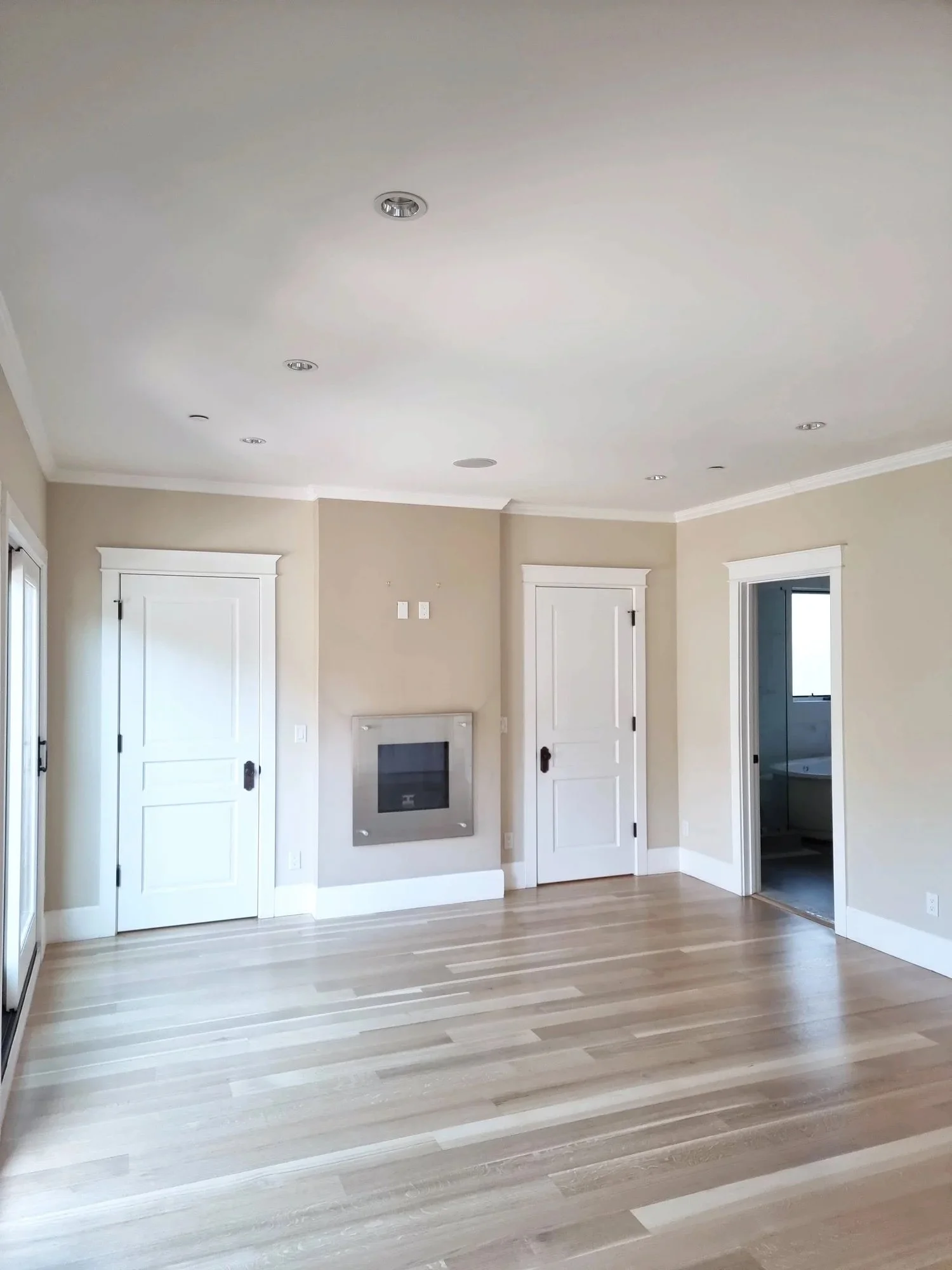
Homeowners describe the same wish in three different ways: remove the texture, make the walls smooth, do a Level 5. Contractors hear three different scopes of work, and the estimates that come back cannot be compared. The short version: texture removal is preparation, not a finished wall. Skim coating, also called smooth walls, is the smooth, primed, paint-ready surface most people are picturing. Level 5 is a finish standard for gypsum board from an industry document. It helps to understand it, but the number alone tells you little about what you are getting. Below is what happens with each option, what you get, what you don't, and when each one makes sense.
Where the Texture Came From
Orange peel and knockdown are spray-applied textures. In many Bay Area houses they went on during construction because they are fast and hide drywall seams and small defects. The trouble starts with large windows and strong daylight. Side light from a window picks up every grain, every patch left by a plumber or an electrician, and every transition between old and new texture. Under evening light the wall looks fine. In daylight it looks tired. So the request almost always sounds like "I want it smooth." The path to smooth comes in three versions.
Option 1. Texture Removal
What is done. Unpainted spray texture is softened with water and scraped off. Painted texture does not soften, because the paint seals it: it is either sanded down to knock off the high points or covered over.
What you get. A wall without bumps, but not a finished surface. Scraping leaves scratches, raised drywall paper, uneven absorption, and the outlines of old patches. You cannot paint that wall. Paint will show all of it.
When it makes sense. As the first step before leveling, when the texture is heavy and unpainted: removing it is easier than burying it under several coats. As a stand-alone "scrape and leave" service, it is almost never what the homeowner actually wanted.
What you don't get. A smooth wall. One more thing: in homes built in 1980 or earlier, old sprayed or troweled texture needs to be tested for asbestos before anyone disturbs it. More on that below.
Option 2. Skim Coating (Smooth Walls)
What is done. Thin coats of joint compound go over the entire wall, not just the seams and repairs, until the coverage is continuous, and each coat dries before the next. The finished surface is sanded as needed until smooth. Light orange peel is usually covered without removal. Heavy knockdown is knocked down first, then leveled. Gloss paint is scuffed and primed so the compound bonds. The last step is primer: fresh compound absorbs unevenly, and paint over unprimed compound looks blotchy.
What you get. A smooth, far more uniform surface: the old texture is covered, and transitions and old repairs are made much less visible. Under strong side light, minor variations can still show on any smooth wall, Level 5 included; the standard itself describes skim coating as a way to conceal minor surface differences and create a more uniform surface, not a perfectly flat one. The wall is primed and ready for finish paint. The room is the same room, but it looks cleaner and more refined. Smooth walls are often what separates a real remodel from "we just repainted."
When it makes sense. Room by room, when the room can be cleared. During a kitchen or bathroom remodel, while the room is open anyway. Before dark paint or semi-gloss, which show everything.
What you don't get. Compound levels the surface, not the framing. A wave caused by bowed studs cannot be pulled out with a few coats. That is a different job. Cracks from house movement and moisture stains need their cause fixed first, not covered. And the honest downside: a smooth wall is less forgiving. Future dents and poor repairs show more than they would on texture.
Option 3. Level 5
What it is. Level 5 is not a technique. It is a level from GA-214, "Recommended Levels of Finish for Gypsum Board," published by the Gypsum Association together with the wall, ceiling, and painting contractor associations. The current edition is GA-214-2021. The document defines six levels, 0 through 5, for finishing gypsum board. Level 4 finishes the joints, fasteners, and accessories but does not add a continuous coat over the field of the board. Level 5 is Level 4 plus a thin continuous coat over the entire surface: joint compound, or a material manufactured specifically for that purpose, such as a sprayed primer-surfacer.
When the standard recommends it. In its own words: where smooth walls will be decorated with non-flat paints (sheen or gloss) or other glossy finishes, where dark or deep-tone paints are applied, or where critical lighting conditions occur. GA-214 defines critical lighting as "strong side lighting from windows or surface-mounted light fixtures." That describes most Bay Area rooms with large windows.
What you get when you order "Level 5." On new drywall (an addition, an ADU, a kitchen with relocated walls), Level 5 is a clear specification, and it belongs in the contract: the contractor owes you a continuous coat over the entire surface, using joint compound or a material manufactured specifically for that purpose, not just finished joints. On existing textured walls, the written scope is usually more useful than the label alone: full-surface skim coat, sanding, primer. The number 5 in the heading of an estimate tells you little. The written scope tells you everything.
When to say "Level 5" anyway. A designer's or architect's specification, gloss or lacquer paint, new walls inside a remodel. We perform to that standard on request. Say so before the work starts, so it is priced and written into the scope.
The Three Options Side by Side
- Texture removal: the texture is scraped or knocked down. Result: a prepared substrate. Right as a step. Does not give you a finished wall.
- Skim coating (smooth walls): thin coats over the entire wall until coverage is continuous, sanded and primed. Result: a smooth wall ready for paint. Right almost every time the goal is "smooth." Does not correct bowed framing or the cause of cracks.
- Level 5: a GA-214 standard, Level 4 plus a continuous coat over the entire surface. Result: a specification the work can be checked against. Right for new walls, gloss paint, and designer-led projects. For existing walls, specify the scope, not the label.
What Drives the Price (and Why There Is No Per-Square-Foot Number on This Site)
There are no prices on our site, and not because we hide them. Two rooms with the same floor area can require very different amounts of labor. What matters:
- Wall and ceiling area, not floor area: tall ceilings add square footage and work from scaffolding.
- How heavy the texture is: light orange peel is covered with less material, while knockdown has to be knocked down and needs more coats.
- Whether the texture is painted, and with what: gloss has to be scuffed, peeling paint removed.
- The number of corners, windows, doors, and niches: a plain wall is faster than a wall with four openings.
- Whether the room is empty and accessible: furniture and appliances are protected or moved.
- Whether it is part of a remodel: when the kitchen is already open, part of the protection and cleanup is already done.
- The finish: gloss paint and a Level 5 specification mean more coats and more checking in side light.
A practical tip for comparing estimates: ask each one to state which rooms, walls, and ceilings are included, whether the coat is continuous or only "where it shows," whether sanding and primer are included, and what happens with painting. Compare that, not the words "Level 5" in the heading.
Older Homes: Asbestos and Lead
Two things an honest contractor tells you before the work starts, not after.
Asbestos. Under Cal/OSHA rules (8 CCR §1529), sprayed or troweled surfacing material in buildings constructed no later than 1980 is presumed to contain asbestos unless an appropriate inspection or testing shows otherwise. Sprayed or troweled wall and ceiling texture falls within that definition. QualiBuild does not sample, assess, or remove asbestos. When inspection, testing, or abatement is needed, qualified asbestos professionals handle it before we disturb the material. We do not sand or cover a suspect material just to keep the job moving.
Lead. Homes built before 1978 may have lead-based paint. In general, the federal EPA RRP rule applies to paid work that disturbs painted surfaces in those homes. Minor repair that disturbs 6 square feet or less of painted surface per room inside is exempt, but preparing a whole room for skim coating, especially sanding or scraping painted texture, can easily exceed that amount. The rule also does not apply to surfaces that a certified lead-based paint inspector or risk assessor has found lead-free, or that a certified renovator has tested lead-free with an EPA-recognized test kit or paint-chip analysis by an EPA-recognized laboratory. Ask any contractor how they handle this before the sanding starts.
How to Check a Smooth Wall
GA-214 sets the inspection rule in plain terms: look from a normal viewing position, at least five feet from the surface, under the lighting that will be in place when the room is finished, natural and installed lighting included. Blemishes should not be visible under those conditions. A primed wall is a useful checkpoint before finish paint. Keep in mind that dark colors and higher-sheen finishes can make minor surface variations more noticeable. GA-214 itself says a full-surface coat minimizes joints and fasteners showing through; it does not promise they vanish. In rooms with large windows, choose matte or eggshell paint for smooth walls. It forgives more than semi-gloss.
Frequently Asked Questions
Are skim coating and Level 5 the same thing?
No. Skim coating is a method: a thin continuous coat over the whole surface. Level 5 is a specification from GA-214 for finishing gypsum board. A traditional Level 5 is a Level 4 finish plus a skim coat of joint compound, but the standard also allows a material manufactured specifically for that purpose, such as a sprayed primer-surfacer. On existing textured walls, what matters is the written scope: full-surface coat, sanding, primer. If your designer calls for Level 5, tell us before the work starts. We will perform to that standard and write it into the scope.
Can I just remove the texture and paint?
No. Scraping leaves an uneven substrate with uneven absorption. Without a leveling coat and primer, paint will show every scratch. Texture removal is preparation, not a finish.
Do the walls need new drywall to be smooth?
In most cases, no. If the board is sound and dry, it is leveled in place. Replacement is needed where there is water damage or the board is soft or delaminated. We decide after inspecting the surface.
Do you skim coat ceilings too?
Yes, together with the walls or separately. We do not remove popcorn ceilings. That is a separate job, often with asbestos testing first.
Planning Smooth Walls in Your Home?
Send us photos, a short video, and rough dimensions of your walls. From a detailed video with dimensions, we'll give you a real price, not a ballpark.
Mikhail Strelkin, Owner, QualiBuild. Licensed, bonded, and insured California General Contractor, CSLB Lic. #1142411. Based in Sunnyvale, serving the San Francisco Bay Area.
Sources
- Gypsum Association, GA-214-2021, Recommended Levels of Finish for Gypsum Board, Glass Mat and Fiber-Reinforced Gypsum Panels: Levels of Finish; Comments on Inspection Criteria, Sanding, and Skim Coating.
- California Code of Regulations, Title 8, §1529, Asbestos: definitions and (k)(5), criteria to rebut the PACM designation.
- U.S. EPA, Renovation, Repair and Painting Program: Contractors and 40 CFR §745.83: minor repair exemption and lead-free determinations.
- USG, Sheetrock Brand Tuff-Hide Primer-Surfacer, submittal sheet: primer-surfacer used in lieu of a skim coat in a Level 5 finish.
Accessed September 2026.